Dr. Ruslan Zhuravsky is one of the very few surgeons in Miami and Florida offering the endoscopic facelift. Although the technique itself isn’t new, it has been gaining renewed popularity worldwide for a simple reason: it delivers a true deep plane lift without any incisions in the visible areas around the ear. Despite the growing interest, very few surgeons actually offer this approach, as it requires a specific skill set and comfort working through a much smaller window into the face.
Dr. Zhuravsky has been performing endoscopic facelifts for several years and has served as faculty at a national meeting dedicated to teaching the technique to other surgeons. This page is designed to give patients a clear, honest understanding of what the endoscopic facelift is, who it’s right for, and how it compares to a traditional deep plane facelift — so you can have an informed conversation with your surgeon, whether that’s Dr. Z or someone else.


An endoscopic facelift is a facelift performed through small, hidden incisions in the hairline, avoiding the classic incisions in front of and behind the ear. It’s essentially a limited version of the deep plane facelift — the same deep ligaments are released to allow a true lift of the underlying structures, but because the skin itself is never cut, the skin itself is not removed.
The DETAILED answer:
The procedure uses a specialized high-definition camera on a long, thin telescope — the endoscope — which looks something like a straw with a lens and light at the tip. This is passed through the small hidden incision, allowing the surgeon to see and operate deep beneath the skin without needing a long incision to do it.
There are two versions of the endoscopic facelift, depending on how much of the face and neck need to be addressed:
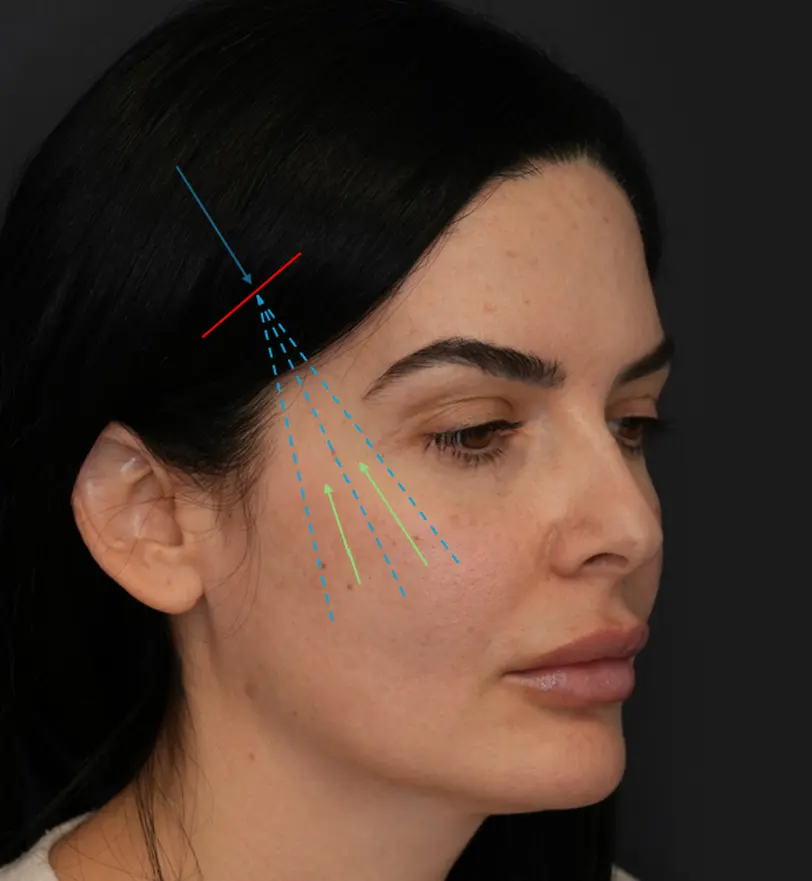
A small incision, roughly 2 cm, is made in the scalp just behind the hairline — the same location used for an endoscopic brow lift. Through this single incision, the surgeon releases the deep attachments of the face and lifts the underlying structures, then secures them in their new position using either sutures or dissolvable devices called endotines.
The DETAILED answer:
The surgeon first identifies the correct plane just above the deep temporalis fascia — finding this exact layer is the single most important part of a safe, effective endoscopic lift. Working within this layer, the surgeon releases the points of strong adhesion that normally prevent the face from moving freely and that are responsible for many disappointing facelift results. This is done the same way it’s done in a browlift: staying in the correct plane, releasing adhesions, and protecting the nerves and vessels that run through the area.
The endoscope is introduced through that same small scalp incision, letting the surgeon see clearly and continue the release all the way down through the face, without ever needing to open it up. This release is the critical step — if it isn’t performed thoroughly, the face will not elevate properly, no matter how it’s secured afterward. Once released, the face is freely mobile and ready to be lifted into its new position.
The face is then secured using one of two methods:
It’s worth being clear about something important here: this is very different from a “thread lift.” Thread lifts insert threads at various depths and simply pull on the face without ever truly releasing it — which is exactly why they so commonly fail to deliver lasting results and produce visible irregularities. In an endoscopic facelift, the anchoring only works because the deep release has already been done surgically. The threads or endotines aren’t doing the lifting on their own — they’re holding a properly released, properly repositioned layer in place while it heals.
If the neck is being addressed as well, a second incision is made behind the ear and around the earlobe. The skin is elevated, the correct layer is identified, and the endoscope is used to release and lift the deep plane of the neck beneath the platysma muscle — the same principle of thorough release applies here too. The platysma is then tightened and secured directly to the mastoid bone (the firm bone behind the ear) using sutures, since the muscle sits close enough to this fixed point to be anchored to it directly.
The main benefit is avoiding incisions around the ear and sideburn altogether. Because there’s less overall dissection, recovery also tends to be faster, with less swelling and fewer visible signs that you’ve had surgery.
Most people assume facial aging is mainly about “extra skin.” In reality, it’s the descent of the SMAS layer beneath the skin that drives most of the sagging we associate with an aging face — and that layer is the real target of any good facelift. But once the SMAS is lifted in cases of moderate to severe laxity, there is often excess skin left behind that needs to be removed as well. That’s the central limitation of the endoscopic approach: it cannot remove skin. It’s best suited to patients with mild to low-moderate laxity.
The DETAILED answer:
The endoscopic lift also has less ability to address significant jowling. Mild jowls improve nicely because the face is lifted vertically, but because the lift originates from a fixed point up near the temple, more pronounced jowling is harder to fully correct this way. Significant jowling is also often a sign that there’s excess skin to remove, which points back toward a standard deep plane lift as the better option.
The neck has a similar limitation. It cannot be improved through the hairline incision alone; it requires the second incision behind the ear, and that incision still can’t remove excess skin unless it’s extended back along the hairline, similar to a traditional facelift incision. That makes the endoscopic approach to the neck best suited to mild-to-moderate laxity and relatively smaller necks.
Candidacy ultimately comes down to your anatomy, the amount of laxity present, your expectations, and your surgeon’s judgment about whether those factors line up for a good result. Generally, the best candidates have mild to moderate laxity that doesn’t require excess skin removal.
There’s also a second group of good candidates: patients who might get an even more dramatic result from a full deep plane facelift, but who would rather accept a slightly more conservative outcome in exchange for no visible incisions and a shorter downtime.

The large majority of endoscopic facelifts are completed without any complications. That said, it is still surgery, and it’s important to understand the risks going in. Most of these mirror the risks of a standard deep plane facelift and brow lift.
The DETAILED answer:
Dimples and irregularities. Because the skin remains attached to the SMAS layer, the sutures or endotines used to anchor the lift can occasionally create temporary dimples where they attach, particularly in thinner patients. This is less common with endotines, though a faint outline of the endotine strip can sometimes be seen through very thin skin. It’s rare, and it resolves as the device dissolves in a few months; filler can be used to camouflage it in the meantime.
Hair loss at the incision. This carries the same risk profile as a browlift incision. It’s most often caused by excessive tension on the skin, which is why we avoid pulling on the surface skin itself and focus on the deeper layers. Done properly, this is very rare, though some inflammation-related thinning near the incision is still possible.
Bleeding, hematoma, and infection are possible, as with any surgery, but are uncommon.
Nerve injury is the risk that deserves the most attention, though it remains very rare. The frontal branch of the facial nerve carries a slightly higher risk with the endoscopic approach compared to a standard deep plane lift, because the endoscopic technique passes directly beneath this nerve to fully release the deep plane, whereas the standard approach passes over it before diving deeper. This nerve controls the ability to close the eye and to raise the eyebrow or wrinkle the forehead. The vast majority of injuries are temporary, resolving within weeks to as long as a year. Permanent injury is extremely rare, at approximately 0.1%.
The marginal mandibular nerve is also at risk, particularly when the neck and lower face are treated. It controls the muscles that pull down the corners of the mouth — a movement most people rarely use anyway, and one many patients wouldn’t mind losing (it’s the same muscle targeted with Botox for a frowning mouth). When affected, it creates an asymmetric smile and speech asymmetry; in these cases, the opposite side is sometimes balanced out with neurotoxin. This injury is uncommon and, in the large majority of cases, temporary, with recovery ranging from a few weeks to a year.
The greater auricular nerve, which provides sensation to the lower ear, is the nerve most frequently affected during facelift surgery in general, though this is typically temporary as well.
A high-quality endoscopic facelift typically lasts 5–10 years.
The DETAILED answer:
When performed properly, deep plane techniques — endoscopic included — reset the operated areas to a more youthful position. That doesn’t pause the aging process itself; it simply moves the starting point back. Results don’t “wear off” the way Botox or filler does. Instead, the face continues to age normally afterward, so five years after surgery, you’ll generally look five years older than you did right after — not five years older than you would have looked without ever having surgery.
Deep plane techniques work because they release the tethering points and reposition the SMAS layer itself to a more youthful position. Skin-only lifts, and some SMAS techniques that rely on tension placed at the wrong layer, tend to relax over time, which is why their lift falls off more quickly.
Recovery is very similar to that of a browlift, with the bulk of it occurring in the first week.
The DETAILED answer:
An elastic compression bandage is worn around the forehead, typically for 2–4 days. Most patients describe very little pain in the first couple of days — more of an aching pressure sensation than sharp pain — and it’s well controlled with the medication provided.
Swelling shows up mostly under the eyes and tends to peak around days 2–3. For some patients, this is mild; for others, it’s more noticeable and may come with some bruising in the lower eyelid area. The swelling can also temporarily exaggerate any facial asymmetry, since it doesn’t always resolve evenly from side to side.
If the neck is treated, there is, of course, additional tightness, discomfort, and swelling in this respective area.
By one week, most patients feel comfortable being seen in public and returning to work, though probably not ready for a formal event just yet. There’s still some swelling around the cheekbones and under the eyes at this stage, and some patients notice a subtle “squishing” sensation around the scalp — this is normal, caused by small amounts of fluid in that space, and it resolves on its own.
By 2–3 weeks, most patients feel fully comfortable in public, with only small, easily concealed areas of residual swelling.
Physical activity resumes gradually: light jogging and stretching after week one, low-to-moderate cardio and light weights by week two, with activity advancing through week three based on comfort. Most patients are back to their regular high-intensity workouts by weeks 3–4.
During recovery, the main goals are avoiding strain that could trigger bleeding in the first two weeks and protecting the areas that were operated on. Cold compresses are especially helpful in the first 48–72 hours, and we ask patients to sleep with their head elevated at least 25 degrees during the first week.
Yes. Procedures such as lip lift, blepharoplasty, fat grafting, laser resurfacing, rhinoplasty, and chin augmentation can all be combined with an endoscopic facelift, depending on Dr. Zhuravsky’s evaluation of your candidacy and whether the added benefits make sense for your goals. A major point that Dr. Zhuravsky likes to relay to all patients is that there are 3 major categories of aging: laxity, volume loss, and skin changes. Each of these categories has its own specific treatments and deserves individualized attention. The endoscopic facelift improves laxity in the face, but cannot compensate for a lip lift. A lip lift improves the contours and proportions of the lip, but cannot address the fine vertical lines in the lips that we treat with lasers. So, adjuvant procedures are often important depending on each individual’s evaluation, desires, and expectations.
The success and safety of any facelift — the endoscopic approach especially — depends on the surgeon’s ability to separate the correct facial planes cleanly, without injuring nearby nerves, muscles, or vessels. If those planes are stuck together, obscured, or the anatomy has been altered by prior treatments, this becomes more difficult.
Energy-based devices (like certain skin-tightening treatments) can dissolve fat and increase scar tissue in these planes. Biostimulatory fillers such as Sculptra, as well as prior thread lifts, can create adhesions as well. None of this necessarily rules out an endoscopic facelift, but it’s important to tell your surgeon about any of these treatments so they know what to expect once they’re in the deep plane.
The biggest difference is the incision. The endoscopic lift uses a small incision hidden entirely in the hairline — and, if the neck is addressed, a second one behind the ear. The standard deep plane facelift uses the classic incision that runs around the sideburn, down in front of the ear, behind the ear, and back along the hairline.
That difference in incision drives most of the other differences:
Dr. Zhuravsky is one of a small number of surgeons in Miami and South Florida offering the endoscopic facelift, and he has taught the technique to other surgeons as faculty at a national training meeting. As with every procedure he performs, his approach is grounded in a genuine understanding of facial anatomy and the deep plane — not a marketing shortcut, but a real, technically demanding surgery that happens to be delivered through a smaller window. If you’re a good candidate, it offers a compelling combination: a true deep plane lift, with no visible incisions and a shorter recovery. If you’re not, Dr. Z will tell you honestly and discuss whether a standard deep plane facelift would serve you better.
If you’re interested in learning whether an endoscopic facelift is right for you, contact Dr. Z Face Plastic Surgery for a consultation in Miami, FL. You can call us directly at (786) 347-6211 or use our website to contact us for an appointment request, and a member of our team will be in touch with you.